
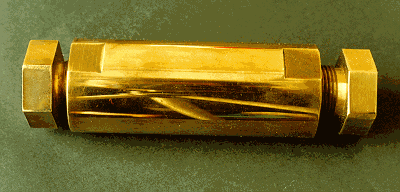
In the early 1960 a demand
for hydrostatic cells capable of operating at low temperatures arose.
Theory predicted the
possibility to observe drastic changes of thermodynamic and kinetic phenomena in
crystals due to pressure influence on electronic structure in metals and
semiconductors.
By that time, the charge
carrier spectra could be determined at normal pressure from the results of
measurements of various quantum phenomena in perfect single crystals at low
temperatures and, often, in strong magnetic fields.
In 1962-63, a high pressure
cell suitable for such measurements under pressure was designed (E.S. Itskevich,
Zh. Eksp.Teor. Fiz., 196222, vol.42, p.1173; Prib. Tekh. Eksp., 1963, #4,
p.148). To hydrostatically pressurize single-crystal samples in a fluid medium,
a piston-cylinder assembly made of beryllium bronze filled with an oil-kerosene
mixture was used. After loading at
room temperature the position of the piston was fixed, and the armed cell was
slowly cooled.
The first measurements
with the cell were made under pressure up to 0.8 GPa. After a number of
modifications of the basic low temperature cell the hydrostatic pressure range
was increased up to 3.0 GPa, the cell dimensions were reduced, high-strength
nonmagnetic steel was used as a material for the cylinders beside beryllium
bronze. All this provided the possibility to use the cells in studies of the
quantum oscillations, the anisotropy of electric conductivity in strong magnetic
fields, and hence to reconstruct the Fermi surface, to observe its topological
transition - (State List of Invention, Certificate no.238, 1982, from IPPH E.S.
Itskevich, A.N. Voronovskii)) and to discover a number of new effects in
connection with the tunnel transport of charge carriers in semiconductors and
superconductors. Modifications of the basic cell for optical and thermal studies
are also available and are now in use in many laboratories.
These
cells developed in the Institute for High Pressure Physics of the Russian
Academy of Sciences provide possibility of electric, magnetoelectric,
thermoelectric, tunneling and superconducting (including HTSC) measurements in
the pressure range up to 3 GPa (430,000 psi) at temperatures from 1 to 400 K.
This piston-cylinder type unit is made of non-magnetic materials and uses a
variety of neutral liquids like benzene, pentane, kerosene, alcohol and so on as
a pressure transmitting media.
The
pressure is generated by loading the High Pressure Unit with a conventional
laboratory press (up to 20 ton) and after fixation the pressure unit may be
removed and placed in the experimental equipment such as cryostat, magnetic coil
and so on. For example, to cool the High Pressure Unit down from liquid nitrogen
to helium temperatures no more than 3 litre of liquid helium is needed.
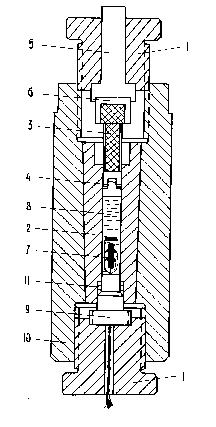
1–fixing nut, 2-inner cylinder (insert),3-piston,4-Bridgman packing5-shaft,transmitting force from press,6-thrust plate, 7-specimen, 8-transmitting medium, 9-stop,10-support shell,11-stop packing.
A.N.
Voronovskii, E.S. Itskevich, V.A.Suhoparov, E.M.Dizhur, State Certificate
no.920033,1980; E.S.Itskevich, L.M.Kaschirskaja, FTT, v.24, no.4, 1982.
Three
ready for sale options are available differing in the upper limit of pressure
range.
|
Option |
#1 |
#2 |
#3 |
|
Pressure range, Gpa |
1.0 |
2.0 |
3.0 |
|
Outer diameter, mm |
30 |
40 |
60 |
|
Inner diameter, mm |
8 |
6 |
6 |
|
Working
volume at Max
pressure, ccm |
1 |
0.35 |
0.35 |
|
Weight, kg |
1.0 |
1.7 |
2.7 |
To provide the possibility of electrical measurements all the
above options include a sample holder with 12 wire feed-trough, and this number
is sufficient as a rule to connect the sample and the pressure gauge to the
measuring circuitry.
We
are ready to meet any special requirements also. If the problem looks too
challenging to you we can help you to solve it using all the experience of our
scientific and engineering staff.
The
main referencies:
1.
E.S.Itskevich, A.N.Voronovskii, Change
of Fermi Surface Topology of Cd under Pressure, JETP Lett. v4, ¹6,1966
2.
E.S.Itskevich, L.M.Fischer, Disappearance of Shubnikov- de Haas effect in
Bi-Sb Alloy under Pressure, JETP Lett. v6, ¹7, 1967
3.
E.S.Itskevich,.V.A.Suhoparov, Pressure Influence on effective electron mass in
InSb, Sov. Phys. - Fiz.Tw.Tela,V.9, ¹1,1968
4.
N.V.Zavaritskii, E.S.Itskevich, A.N.VÏronovskii, Measurements of Lattice
Vibrational Spectra and Electron-Phonon Interaction in Superconductors under
Pressure., Sov. Phys. - JETP v60, ¹4,1971
5.
A.N.Voronovsky, E.M. Dizhur, E.S. Itskevich,
Variation of Phonon Energy in Ge under Pressure up to 3 GPa, Sov. Phys. -
JETP, v.77,¹3,1979
6.
V.F.Kraidenov, E.S. Itskevich, Thermopower of Cd under Hydrostatic Pressure up
to 3 GPa near electron-topological Transition., Sov. Phys.- Fiz.Tverd.Tela,
v37,1995
7.
A.N. Voronovskii, I.E. Itskevich, L.M. Kashirskaya, V.D.Kulakovskii, B.K.
Medvedev, V.G. Mokerov. Persistent photoconductivity in hydrostatically
compressed, selectively doped n-AlGaAs/GaAs structures. JETP
Lett. 42 (10), 501-505, 1985.
8.
E.M.Dizhur,A.N.Voronovsky,E.S.Itskevich,I.N.Kotel'nikov,A.Ya.Schulman,
Oscillations on Tunneling Conductance of Schottky-Barrier n-GaAs/Au Junctions. -
High Pressure Research,1992,v9 - v10, No.1-2, p.370-373
9.
E.M. Dizhur, E.S. Itskevich, L.M. Kashirskaya, A.N. Voronovsky, T. Malik, R.A.
Stradling, W.T. Yuen, Galvanomagnetic measurements of the 2d electron-hole gas
in gasb/inas/gasb quantum wells under pressures up to 2.5 GPa. -Physica Status
Solidi, 198 (1), 1996, p.289
10.
E.M.Dizhur, A.N.Voronovsky, The Evidence Of Weak Localization In 2deg From
Studies Of Pressure Induced Semimetal-Semiconductor-Insulator Transitions In
GaSb/InAs/GaSb Quantum Wells. -Phisica
Status Solidi, (b)211, 449(1999
Contact person: Dr. Valentin Ryzhov. E-mail: ryzhov@hppi.troitsk.ru

~ About HPPI ~ Scientific divisions ~ Scientific
activities ~ Our products ~
~ Office of the director ~